I traveled to San Juan Island in January 2023 to see if the rumor I had heard is true that you could see Short-eared Owls there in winter. I didn’t see groups of people hunched over their cameras en masse in any of the likely spots, nor were there any reports of the species on eBird, so it was quickly clear to me that for owl photography it was a fool’s errand.
San Juan Island is famous for its naturalized population of red foxes. Although most folks crowd near fox dens in the spring to photograph the kits, the foxes are there year-round so supposedly you can see them any time of year. I now have one data point that says it’s not common to see them in winter. Strike two.
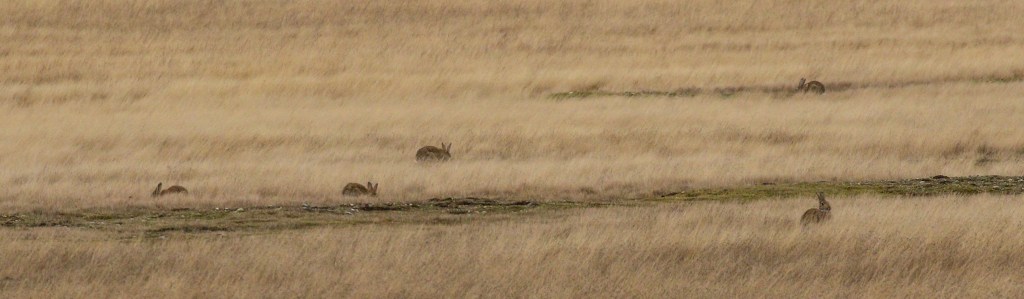
My thoughts turned to river otters. I’d heard stories of these otters galloping over the prairie at the San Juan Island National Historic Park. Surely spotting otters along the water nearby would not be hard. Well… At least I had the bunnies.
In the park, much of South Beach is covered in small cobbles, rocks that have been smoothed and rounded over time by crashing into one another in the waves. As soon as I started walking, my childhood ritual of rock hunting instinctively took over, and I could not pull my eyes off the ground. I scoured the colorful array for cool looking rocks.

At South Beach, they all seemed to be cool-looking, and I generally resisted the urge to take the entire beach home in my pocket. I occasionally picked one up and held it for a while, then released it back to anonymity on the beach. I still have rocks from my childhood, and I don’t need more, especially now that any space in my house dedicated to natural history is occupied by an ever-growing collection of beaver-chewed sticks. In the end, I only retained one small stone, which I think is actually a small bit of broken brick, now as rounded as its native-rock brethren.
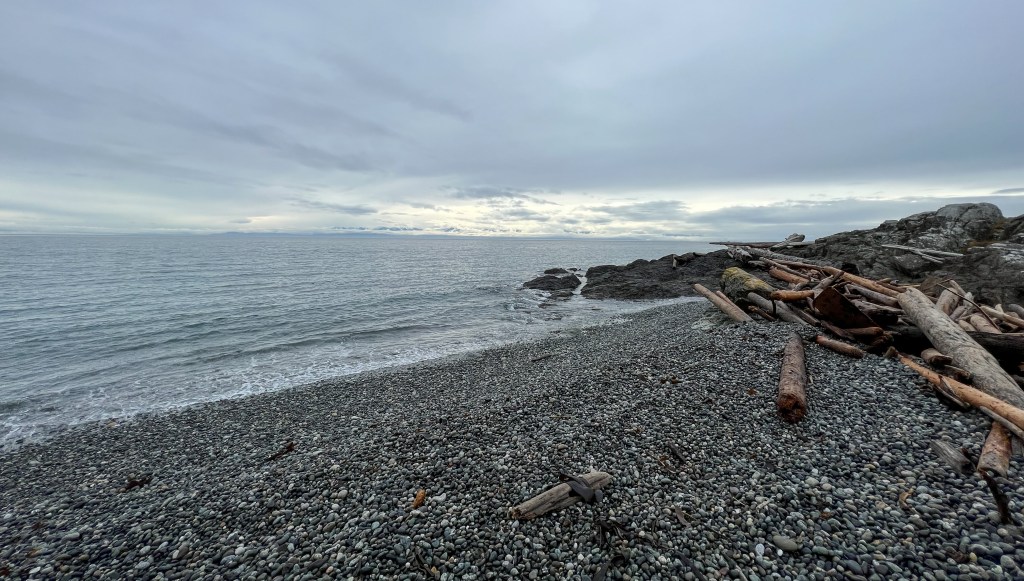
My path along the beach was narrowly defined by saltwater lapping on the shore on one side and a seemingly impenetrable mass of driftwood on the other.

Just above the normal water line, South Beach is absolutely covered in driftwood. The color of the wood changes with age the further it is from the water. Closest to the water the wood is bright and fresh. These newest deposits are red or yellow or gleaming white. The colors mature into shades of brown in the middle. The landward-most and oldest logs are gray. There are acres and acres and acres of it.

Despite the purpose of the walk being ostensibly to look for otters, I couldn’t unglue my eyes from the rocks. Practices cemented in childhood are hard to undo. Eventually I came to a rock outcropping that extended into the water and presented a barrier for continued beach-walking. My choices were to try to scramble over the wood to a trail and get back to mammal-searching, or I could turn around call it a day.
Not in a hurry, I stood with my indecision for a moment. I didn’t want to risk injury on the slippery wood, so there would be no trail hiking today. But I wasn’t ready to part ways yet with this ocean, this beach, this day. Working up the ertia (opposite of inertia) to turn around and retrace my steps to the parking lot, a journey that would reveal nothing new as I would see all the same rocks I’d just looked at, I looked down again at the rocks. But this time more than rocks filled my view. Lying on the rounded stones before me was a completely fresh beaver-chewed stick, as if a beaver had sat in this spot on the beach the night before for a snack and left its scraps behind.
Whaaat? I could hardly believe it.

For one, beavers would not be living anywhere near South Beach. It’s an ocean beach, waves crashing, not hospitable for a species that lives in dens and lodges made partially of mud, which would be destroyed by waves crashing. No streams enter the sea close to South Beach. There are no estuaries or open-water ponds near South Beach. Despite the incredible volume of horizontal dead wood, there are very few living trees growing on this part of the island. If some poor beaver migrating through the saltwater washed up here in need of food, it would have been out of luck. This stick had to have floated there. Hadn’t it?
I realize now I am stick-biased. The only time I would have expected a beaver stick on the beach is if the beach were at the mouth of a river or along the shore of some of our large rivers. And even those situations are new to me in the last year or so. But to be on an ocean beach with no freshwater input in the vicinity and still find a beaver stick? I felt like I’d struck gold (or pyrite, like I did as a kid once while rock hunting).
I’d been singularly focused on the beach rocks up until that impassable outcrop, which forced a broader view. As soon as I found one stick, my beaver-stick search-image kicked in, and before leaving that spot, I found two more.
Making my way back the way I’d come, in no time another very bright white brand-new stick presented on top of the rocks that I had just been staring at. The thing could’ve whacked me over the head, and it would’ve had the same surprise effect.
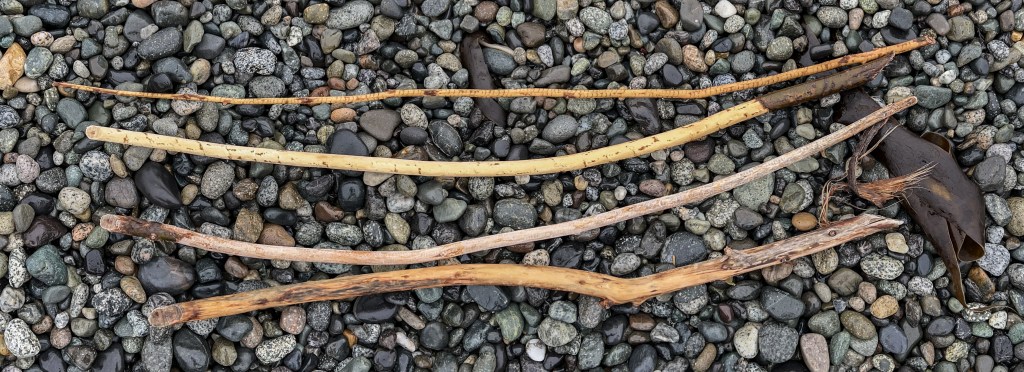
From that moment it was game on. In the following 45 minutes I found another 8 or so beaver-chewed sticks. One of them was among other wood bits on a well-worn path from the parking lot to the beach.
Before meeting Pamela, my girlfriend, finding beaver-chewed sticks along beaches did not seem realistic. I had imagined how cool it would be to spot a log among driftwood that had been downed by beavers. But that felt like something akin to a theory I would never prove.
Last June (2022) she and I went to the beach where the Elwha River empties into Neah Bay, and the moment we got to the sandy shoreline she looked down and found one. I couldn’t believe it. Then she found another. Then it occurred to me to start looking, and I found them too. We were both gleeful imagining all those sticks coming down from the meals of beavers somewhere up higher in the Elwha system. We wondered if maybe a dam broke. After all, there were so many sticks. Lots of them were gray burnished pieces of driftwood by the time we came up on them. Driftwood beaver sticks!
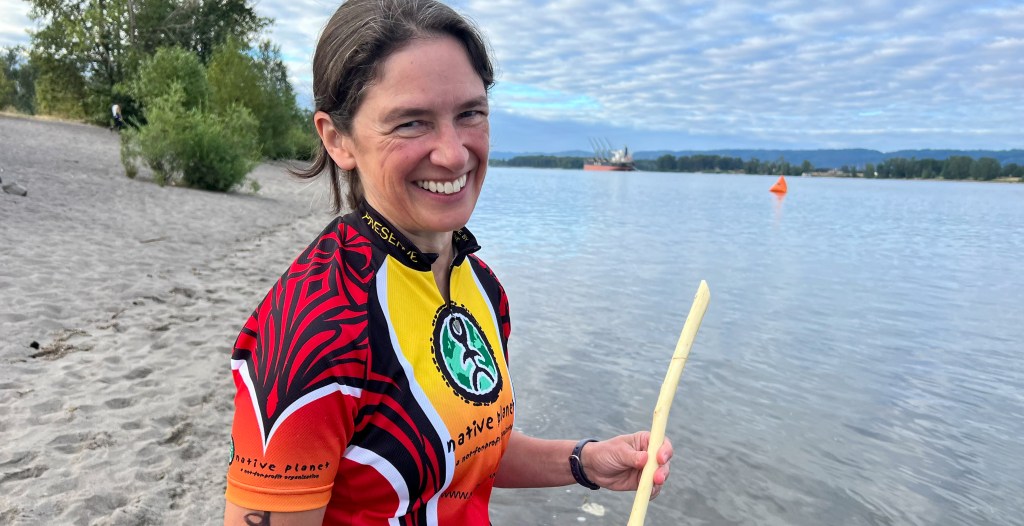
In August we were outside of Portland, Oregon, for a triathlon along the Columbia River. The swim was in the river, and we had to walk up the beach to get to the race start. Sure enough, Pamela started finding beaver sticks. These sticks were freshly chewed. What a great way to start a race.
At the time I first penned this story in mid-January 2023, Pamela had twice found beaver-chewed wood at Alki Beach in Seattle. The first was a large piece that she spotted in the crashing waves, just floating there by itself before her. The second was a very tiny little stick that she found while participating in the freezing ice cold New Year’s Day plunge. At the end of January I went diving at SeaCrest Park, which is on the east side of the Alki head, the west side of Elliott Bay. Pamela was there for shore support, and my parting words as I got in the water were “Find beaver sticks!” She did.
Down at South Beach on San Juan Island, I was alone and had zero expectation of finding any beaver wood. And yet I found some. And not just one lucky stick, but 10 or 12 sticks as I walked along only the outer edge of the wood field. I covered a very small portion of the driftwood, and I still found a respectable supply of food scraps. Based on level of desiccation, the sticks ranged in age considerably. Some could have been eaten the day before, others looked to be a number of years old.

Another reason I was so surprised by the presence of the beaver sticks at South Beach is because someone told me there were no beavers on the island. It was the same lady who told me there would be owls. As with the owl [mis?]information, I had taken her at her word. I believed the local so never looked at maps of San Juan Island to realize there’s plenty of good beaver habitat.
There are beavers on nearby Guemes Island, Cypress Island, and Stuart Island. Those islands have practically no open water, and yet somehow beavers managed to swim through salty seas and navigate thick conifer forest to find the one tiny pond available to them. So of course San Juan Island, which has several streams and ponds and wetlands, should have beavers.
Some of the sticks I found were brand new and had not been subjected to the ravages of traveling by sea, at least not very far. The closest stream outlet to where I found the fresh sticks is about a mile away. It’s comprehensible a beaver took a bit of a shrub, held it in its mouth as it clambered over the piles of driftwood at that stream outlet, then swam a mile with this one stick in its mouth to have a peaceful bite to eat far away from the family. Didn’t want to share. A little adventure. Some good exercise. It seems like a stretch, but it’s physically possible if not improbable.
What about the rest of the beaver sticks, the ones that weren’t brand new? It doesn’t take a driftwood scientist to know that most of the wood found on beaches didn’t originate from the beaches on which it is found. That’s why it’s called driftwood. It drifts there. From… somewhere else. Wood floats and is hearty enough to withstand extreme ocean conditions, so in addition to logs from fallen trees, you also see old railroad ties, cut boards and lumber, telephone poles, and pilings of all sorts wash up on beaches. So why not beaver sticks?
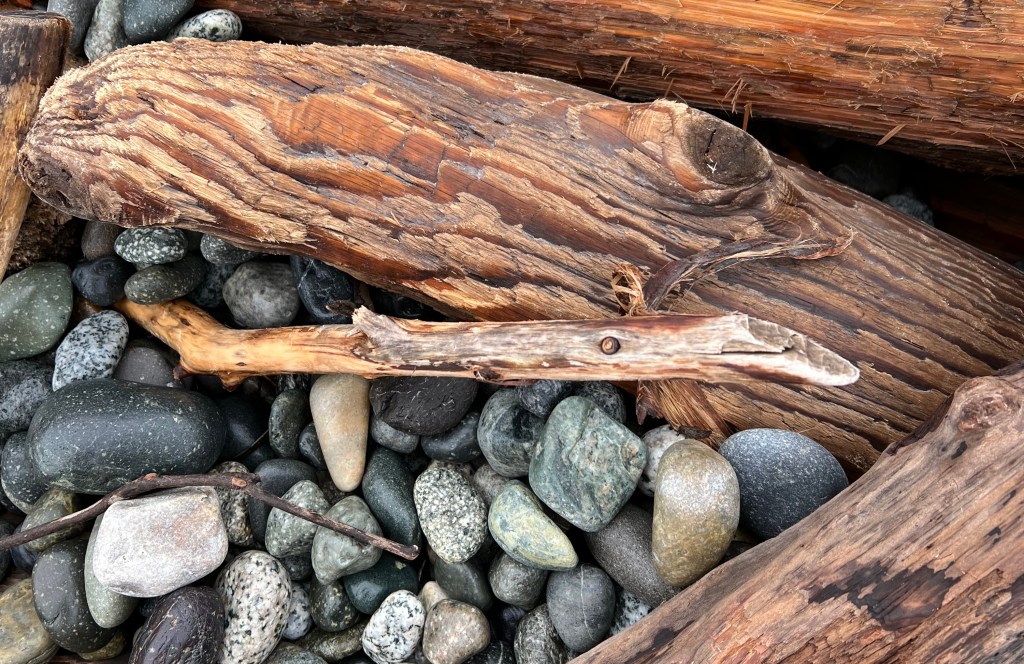
As I considered the travels of wood on the ocean, I began to wonder what stories are hidden in each piece. Where did it grow when it was a tree? How many years ago did it first take root? Could it have been in the hundreds? The thousands? What journey did it take to get to saltwater? Was it growing near a river or shoreline and had a very short journey to the water? Was it cut down and carried to water? Was it cargo aboard a boat or a ship that capsized? Was it a part of a boat or a ship that capsized? Were celebrations or tragedies involved in its origins? How long was it in the ocean? Might I have passed it on a boat in my past? Or walked under it in a forest? How direct or circuitous was the route that it took to get here? How many beaches did it touch on before? What birds landed on it? What fish huddled in its shadow to become invisible to other bigger or hungrier fish? How many storms did it ride?
And what of small pieces of wood like these thin little beaver sticks? They would be effectively invisible in the ocean. Two of my pet peeves are the words flotsam and jetsam, but that’s pretty much what wood as small as beaver sticks would have become a part of at sea.
And finally, what ocean currents carried it to rest on that beach, on South Beach? Right here I would love to be able to insert some information about ocean currents and how they deposit wood on shorelines. I would love to open up a map of ocean currents and trace where the wood on South Beach came from. But my rudimentary searches were fruitless. As tides rise and fall, currents shift direction. Water mixes. Storms blow in. Maybe someone who’s been studying currents in the San Juans can tell me, but my layman’s interpretation is that those beaver sticks could have come from just about anywhere.
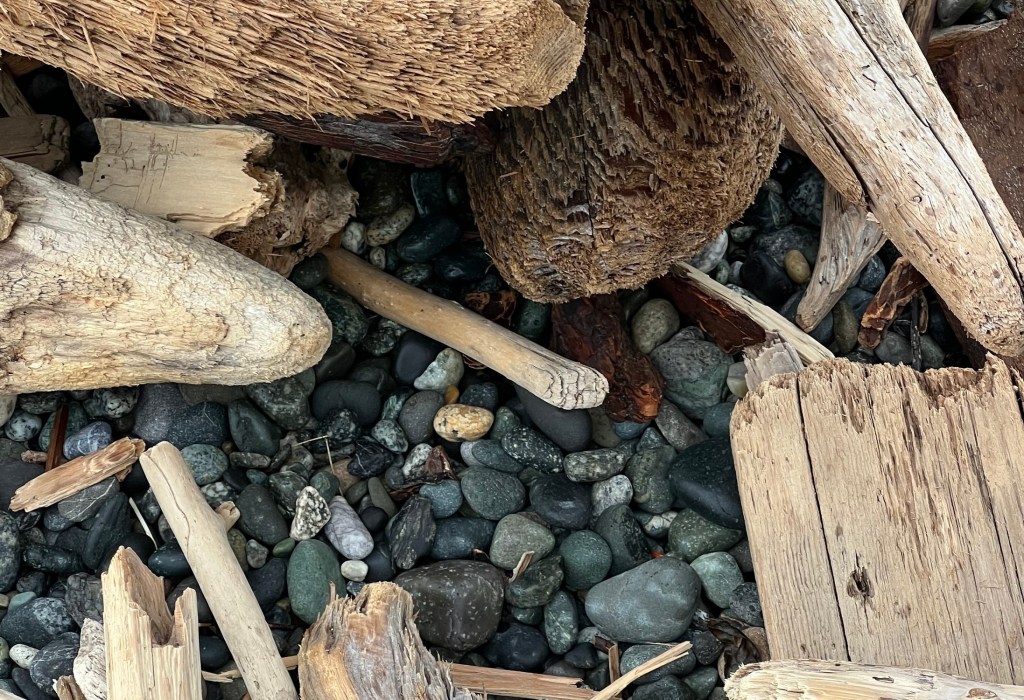
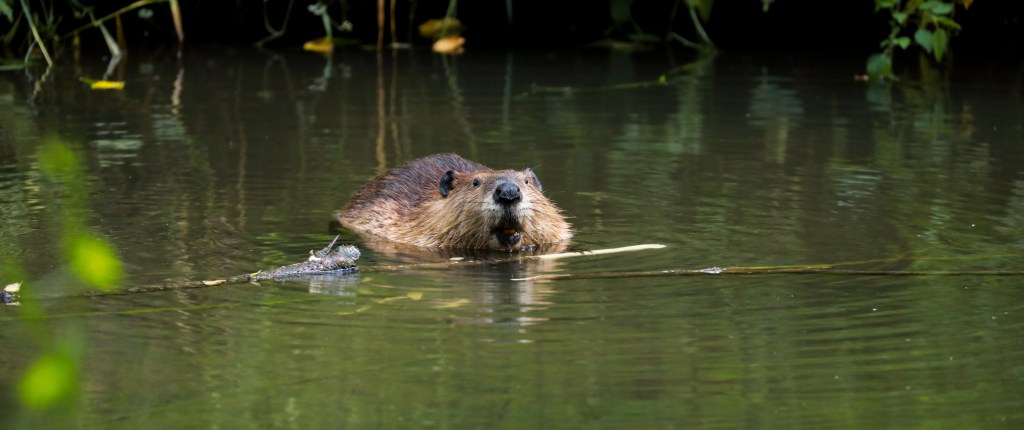
That I found so many beaver sticks in such a short amount of time on an extremely limited pathway next to a single driftwood deposit suggests there is likely a very large quantity of beaver-produced driftwood among the world’s extant piles. There was a time in our nation’s history, before any of us alive today were born, that beavers were so thoroughly trapped out that populations ceased to exist in much of their original range. Before that time, they were abundant and probably found in just about every fresh water body with a low enough gradient. Their effects on ecosystems are only now being realized and deduced as populations continue to return. In Europe, their native beaver was nearly wiped out before ours, and populations of the Eurasian beaver are slow to rebound these hundreds of years later. The enormity of the effects those animals had on the landscape is still unknown. We may never uncover all the means and depths and breadths. I search for clues everywhere I go. I try to discern whispers from the past, the invisible, the things we don’t yet know, conjure them out of the ethers by thinking about beavers more than most people would probably call healthy.
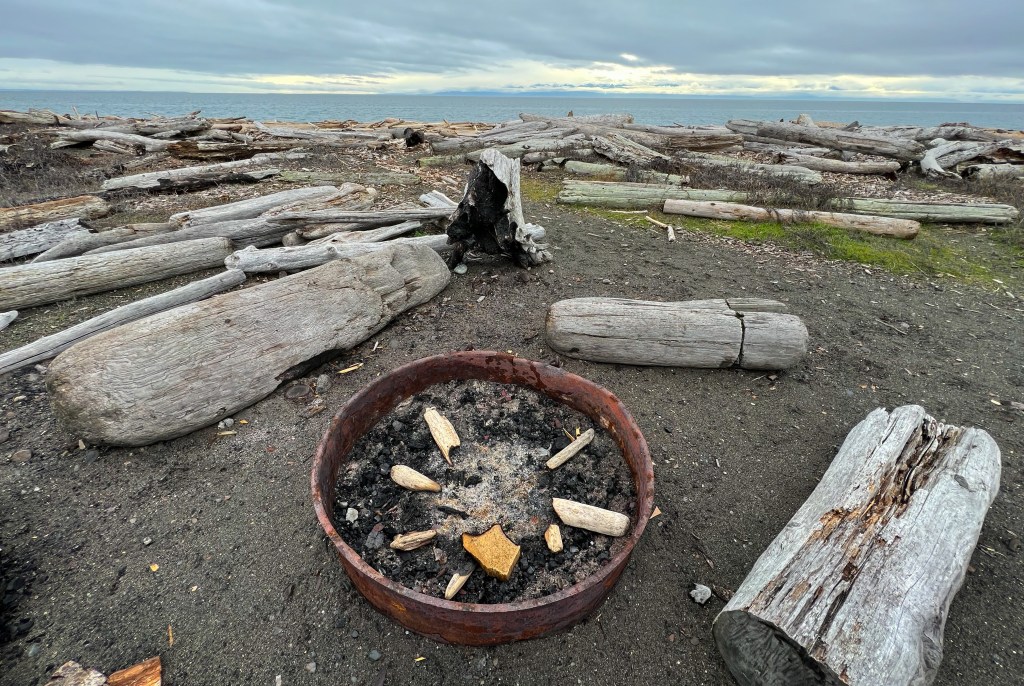
Then I find myself on a rocky beach in winter staring at stones, hoping for owls and otters and foxes, but finding beaver sign. Fresh sticks atop the high-water mark. Older sticks wedged under beach rocks shifted in stormy surges. Weathered sticks jammed and stuck and poking out from under large logs. Small sticks lying on footpaths as part of the trail substrate. And ashes in the fire pit. How many, I wonder, have been used as kindling? They are, after all, the perfect size to start a fire.
My list of questions grows. Could any of these sticks I find pre-date our statehood? Probably not. Maybe? If I were walking on this beach before widescale trapping, how many more beaver sticks would I have found? How much did beavers contribute to ocean driftwood in the past, and how much do they now? Are there new secrets to be unlocked in the DNA of this driftwood?
When I first started walking up South Beach in mid-January, it was hard to keep my eyes from habitually searching the ground for cool rocks. I occasionally remembered to pry my eyes up to see if a fox or otter happened to be staring back at me. By the time I finished, all I cared about was the wood. And probably all the while, foxes peered over my shoulder to see what was so interesting, and the otters just laughed.
Coda
Before leaving South Beach for the ferry back to the mainland, it was already clear this was a story that needed to be written. I went over to photograph a fire pit as I pondered beaver-stick driftwood as likely kindling. I found another beaver stick.
The next morning, I went for a run in Anacortes and decided to run over to Cap Sante, a place I had never been. I followed the foot path until it ended at the marina’s breakwater then walked down a few steps to the landing. From the landing, the stairs split towards open water in one direction and the marina in the other. I turned towards the ocean side, as that’s where the driftwood was. One step down and the very first thing I laid eyes on: a beaver-chewed stick.
Apparently the stuff is everywhere.
 BeaverDisco